




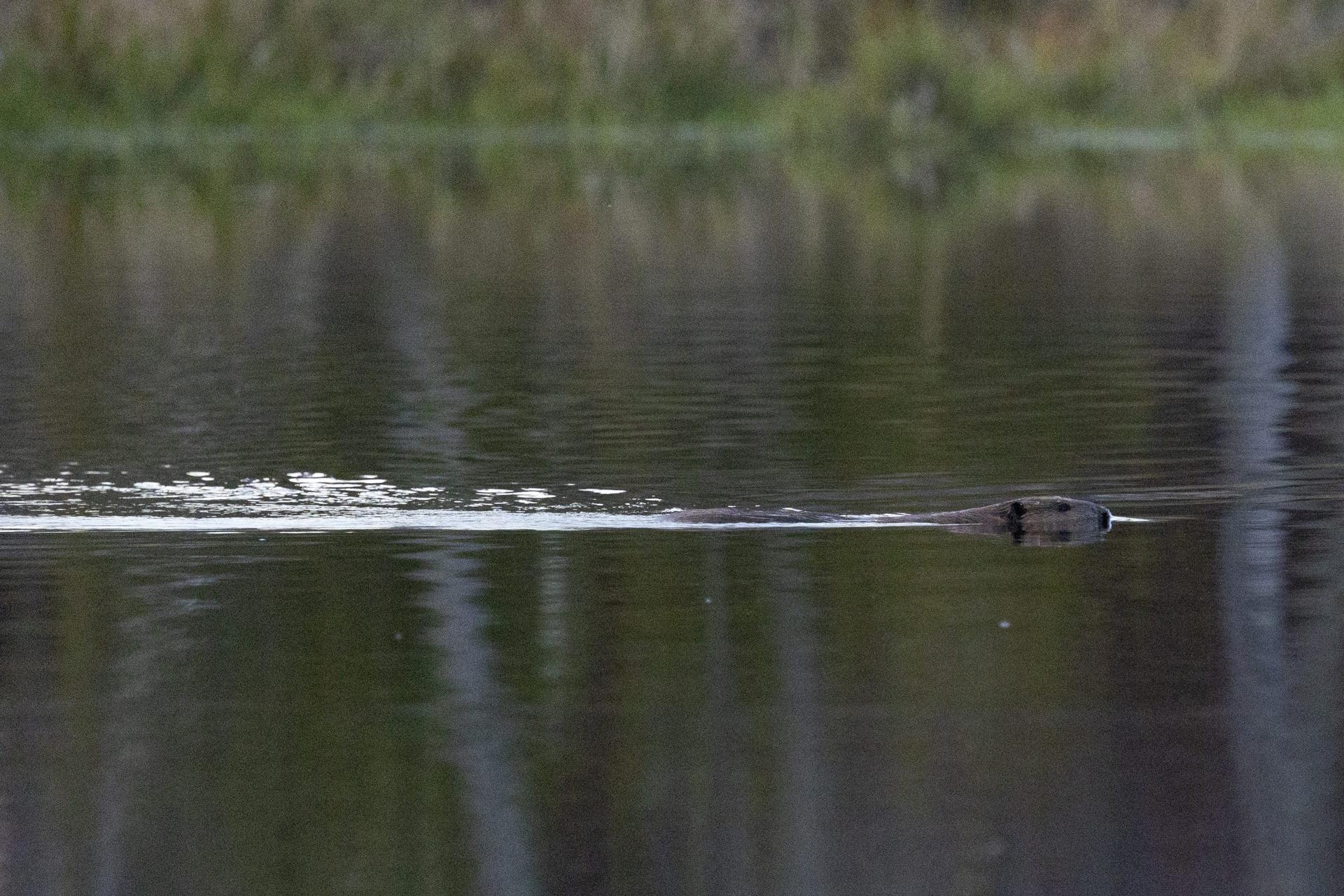


Members of an ad hoc Wisconsin Department of Natural Resources committee are urging wildlife regulators to work with a national expert as they finalize recommendations to guide state beaver management policy for the next decade.
Researchers and conservationists serving on the advisory body — which is largely composed of DNR staff and government and tribal representatives — hope that including additional scientific expertise, and even a potential computer-guided aerial beaver dam mapping survey, could assist regulators at a time when climate change is beginning to significantly alter Wisconsin weather patterns and pose widespread ecological risks.
“We’re taking our species out faster than they can recover, and when we are overexploiting our trout, when we’re overexploiting animals, plants, habitats, that’s going to make us lose these species faster,” said University of Minnesota ecohydrology professor Emily Fairfax, who has helped review and fact-check several beaver management plans and recently spoke to the committee. “I don’t think we have time to wait — full stop.”
A shift would transform long-standing beaver policy that frames the critters as a nuisance species.
The U.S. Department of Agriculture’s wildlife services program has removed beavers and their dams in Wisconsin since 1988 under contract with the state, along with local governments, railroad companies and Indigenous tribes.
At least five states across the Mississippi River basin and Great Lakes region contract with the federal wildlife services program for beaver removal, but Wisconsin stands out among states for the quantity of beavers and dams USDA employees clear, the millions of dollars Wisconsin has invested to do so and the state’s justification.
Current trout policy includes killing beavers
USDA killed roughly 23,500 beavers across 42 states in 2024, about 2,700 of which were in Wisconsin, ranking the state among the top five in the nation.
In Wisconsin, the agency focuses on abating transportation hazards, such as flooded roadways. But, perhaps most controversially, about a third of sites where USDA traps beavers are coldwater streams.
Wisconsin currently prioritizes maintaining free-flowing conditions on the state’s prized coldwater streams, partly to appeal to its “customers” and their fishing preferences.

But the strategy has faced increasing scrutiny, even among anglers, who are divided over the issue. Some beaver advocates say the state agency charged with protecting and enhancing natural resources shouldn’t let commercial interests unduly guide its decisions.
In 2025, the agency trapped and cleared dams in more than 1,550 miles of coldwater streams — roughly the driving distance from Milwaukee to Salt Lake City, Utah. The DNR uses proceeds from annual trout fishing stamp sales to finance the annual undertaking.
At least two other states, Minnesota and Michigan, have employed the USDA for trout stream clearing, but at a significantly reduced scale.
The DNR doesn’t know the impacts of these policies on Wisconsin’s beaver population, as it ceased conducting aerial surveys in 2014. Agency staff, instead, estimate beaver numbers and harvest impacts using trapper surveys and voluntary reporting of annual take. Staff believe the population remains stable statewide or is even growing.
Conservationists are calling on the DNR to systematically survey the state’s beaver population. Without obtaining a reliable count, they say, it’s impossible to devise a science-based management plan. Even if beaver removal continued on trout streams, critics say the state could better estimate the population by having trappers register their beaver take, as the DNR requires for turkey, deer, bobcat and bear harvests.
Meanwhile, an expanding body of research is showcasing beavers’ ecosystem and economic benefits and the drawbacks of removal.
Beaver dams help limit flooding
When beavers remain on the landscape, they create wetlands, which mitigate climate change impacts like drought, wildfires and flooding. Problems thought to be endemic to the American West are now creeping eastward.
Thunderstorms wreaked havoc in southeastern Wisconsin last summer, bringing more than 14 inches of rain to some parts of Milwaukee within 24 hours on Aug. 9-10. Roughly 2,000 homes sustained major damage or were destroyed in the ensuing floods, and the county now faces more than $22 million in public infrastructure repairs after being twice denied federal disaster assistance.
Beaver dams can dissipate torrents of water when the sky opens — even to the city’s benefit.
Using computer models, University of Wisconsin-Milwaukee researchers estimated that the Milwaukee River watershed could accommodate enough beaver colonies to reduce flood water volumes by 14% to 48%.
Wisconsin beaver policy understudied
But scientists face decades of institutional consensus in Wisconsin that beavers degrade stream habitat and threaten wild coldwater fisheries.
DNR fish biologists say that beavers warm water temperatures and plug coldwater streams with silt. When unobstructed, the water bodies, which tend to contain few fish species, flow fast and hard.
“Past studies have identified some positive but mostly negative effects of beavers on trout, and my research builds upon this,” DNR fisheries scientist Matthew Mitro told the beaver management committee. “The option for lethal removal (of) beavers is an important tool that should remain available for resource managers.”
Yet critics charge DNR biologists with managing streams for the primary benefit of one species by trapping out another, justifying the practice using research that hasn’t undergone scientific peer review.

A 2011 academic review of beaver-related research conducted in the Great Lakes region, which predated Mitro’s recent research, found that 72% of claims concerning beavers’ negative impacts are speculative and not backed by data, while the same held true for 49% of positive claims. The negative claims included the idea that beaver dams warm stream temperatures and block trout passage.
DNR biologists often note that academic literature largely has been conducted in the western United States and can’t be directly transplanted to Wisconsin’s comparatively flat landscape.
That is all the more reason to get off our haunches and wade into beaver ponds, Fairfax said.
“We have to follow that up by collecting our own data sets,” she said. “We have to publish them in peer-reviewed journals and get that scientific stamp of approval.”
Beaver trapping and natural predation are distinct from targeted eradication, Fairfax noted. The former can be sustainable, while stream-wide depopulation and dam removal can damage entire ecosystems.
It’s also possible that stream clearing prevents beavers from moving to parts of Wisconsin where they are wanted or where they could thrive with fewer conflicts.
Federal government assesses Wisconsin’s beaver dealings
The DNR beaver management plan’s update coincides with a new USDA environmental assessment of the potential impacts of its beaver and dam removal in Wisconsin.
A conservation organization founded by beaver management committee member Bob Boucher announced its intent to sue the federal agency to compel it to update its previous assessment, published more than a decade ago. Then Boucher threatened to sue the DNR after it wouldn’t release a draft of the new one, currently under review.
The 2013 assessment determined that USDA’s involvement in clearing streams and conflict areas did not significantly impact the beaver population. It estimated wildlife managers would only trap about 2,000 beavers annually, but the agency exceeded that figure within a few years.
The USDA recommends staying the course, using lethal and nonlethal methods. When analyzing alternatives, the agency concluded that other wildlife managers would continue trapping with or without federal involvement.
The USDA allocates some funding for the installation of flow control devices that can reduce the footprint of beaver ponds by lowering water levels. But nearly all beaver conflict sites the USDA handles in Wisconsin are managed through trapping. Levelers do have limited effectiveness in settings like high-flow streams or infrastructure-heavy floodplains.

Wildlife managers say that they need flexibility because no two beaver sites are identical.
“We’re not against beaver complexes,” DNR fisheries biologist Bradd Sims told committee members. “We’re not against ecosystem diversity, and I don’t know why people try to paint us that way. We’re an open-minded bureau that’s open to different management styles.”
Trout and beaver proponents do agree that climate change poses an existential threat to biodiversity. While the former group might view beavers as harmful to coldwater streams, the latter see their potential as a partner in creating resilient landscapes that accommodate not only fish, but also frogs, turtles, bugs, bats, birds and humans.
The committee’s next meeting is March 18 in Rothschild, Wisconsin. Ultimately, DNR staff will rewrite the current plan, release a draft for public comment and discussion at open houses, and present a revised document to the state’s natural resources board for ratification.
This story was produced in partnership with the Mississippi River Basin Ag & Water Desk, an editorially independent reporting network, of which Wisconsin Watch is a member. Sign up for Wisconsin Watch’s newsletters to get our news straight to your inbox.