






The Pierce County dairy currently houses 1,700 cows. The expansion would make it the largest factory farm in the seven county region of Barron, Buffalo, Dunn, Pepin, Pierce, Polk and St. Croix counties.
Local opponents to the Ridge Breeze expansion have been working against the plan since 2024, packing public hearings and combing through public documents. The activists have uncovered inconsistencies in the dairy’s application — which first had to be sent back by the DNR because the farm’s plan for managing its manure said it would spread liquid manure on nearby fields without the permission of the property owners.
If expanded, the farm would produce 80 million gallons of liquid manure every year.
Despite the initial application’s problems and the widespread opposition, the DNR approved the expansion in February 2025.
Tuesday’s hearing was the beginning of the process to challenge that DNR permit decision. The contested case will be decided by Wisconsin Administrative Law Judge Angela Chaput Foy. Foy’s decision will be appealable to the state circuit court system.
On Tuesday, activists involved in the fight against Ridge Breeze tied their work for the past two years to the recent efforts in other parts of the state by residents working to stop the construction of massive AI data centers in their communities.
Both conflicts have brought together people of diverse political persuasions to fight outside corporate interests that try to assert the authority to build whatever they want, no matter what the ramifications are for local water, energy use, economies or quality of life.
“Whether it’s a data center coming into your community, or a massive factory farm like Ridge Breeze, everyday people need to continue to stand together, organize and create greater change that will protect and put the power back into the hands of regular people,” Danny Akenson, an organizer with Grassroots Organizing Western Wisconsin, said at a news conference before the hearing.
Akenson told the Wisconsin Examiner that it’s no surprise that people of “all political stripes” are seeking basic protections for their communities against corporate extraction.
“The reality is that rural America — and really communities of all different sizes, rural, urban, suburban — are standing up against massive corporate overreach and the extraction of wealth from their communities into the pockets of shareholders and investors,” he said.
GRO-WW has been heavily involved in the fight against Ridge Breeze and against the growing popularity of factory farms across western Wisconsin. The organization helped connect the plaintiffs in the contested case with attorneys from Midwest Environmental Advocates to dispute the permit decision.
Their petition against the permit asks that at the very least it be modified to make sure the DNR is monitoring the local water so the farm is held accountable if the state’s groundwater pollution rules are violated.
“There is substantial concern as to whether Ridge Breeze can appropriately manage the manure and process wastewater it intends to generate following expansion,” the petition for review states.
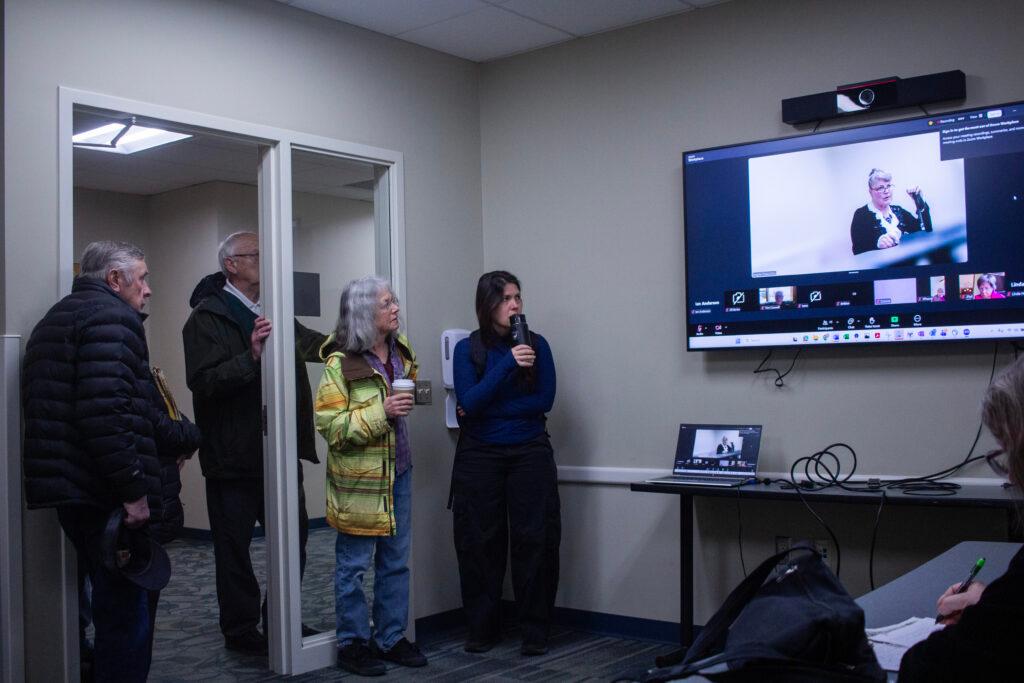
The day began with several hours of public testimony. Members of the public packed into the small conference room where the hearing was held and two overflow rooms, while dozens more watched on the Zoom stream.
Only opponents of the farm expansion testified, largely rehashing the arguments they’ve made against the expansion for years — that it doesn’t have an adequate manure spreading plan, that the farm traffic will be too loud, that the farm’s location will harm local trout streams and that the already high level of nitrates in the local groundwater will only be made worse.
Juliet Tomkins, a retired agricultural lawyer who operates a small Pierce County farm, questioned how the judge would feel if the case were about her drinking water.
“I would like you to think about how you would feel if the regulator of your water supply that keeps you and your family and your loved ones safe failed to keep 80 million gallons of contaminants annually out of your water supply because the regulators inadequately reviewed the contamination procedures, and the result of this inadequate oversight was the permanent contamination of your water, the groundwater, for generations to come,” Tomkins said.